The Vial and the Verdict: What the Numbers Actually Say About Starting With Peptides or SARMs


This piece does not endorse SARMs or recommend using them. Several compounds named here are prescription or compounded medications available only after a licensed clinician evaluates a patient. Every figure traces back to a primary source, listed below.
You’ve probably had this moment yourself, and it almost never happens in a doctor’s office. It’s eleven at night, phone light on your face, a half-read forum thread open, a cart with something called RAD-140 sitting one tab over from a peptide calculator. Nobody scores anything in that moment. You just decide, based on a review, a price, a promise.
This piece tries to do what that late-night scroll never does: treat the decision like a background check, not a purchase. If you were about to let a stranger into your bloodstream, you’d want to know who vouches for them, what’s actually in the box, and who answers the phone if something goes wrong. Score the two paths, peptides and SARMs, on those terms, and the “safest way to start” stops being a molecule and becomes something more like a structure of accountability.
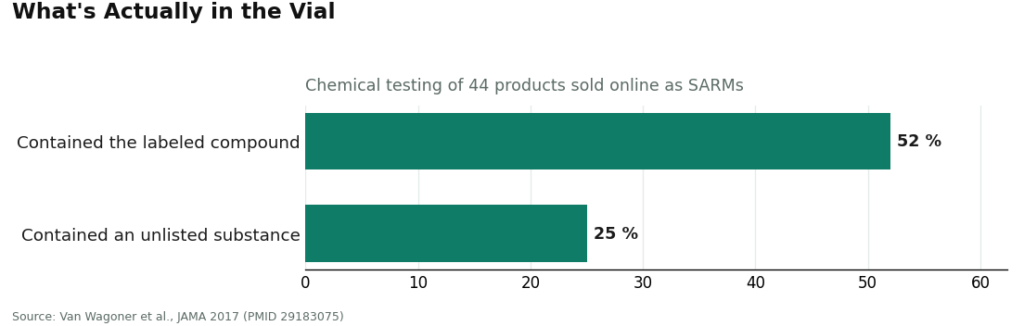
Two numbers anchor the whole comparison before any scorecard gets built. The first is zero: the number of SARMs approved by the FDA for human use, full stop, according to the U.S. Anti-Doping Agency, which describes all SARMs as investigational and unapproved [2]. The second is 52%: the share of 44 products sold online as SARMs that, when chemically tested for a JAMA study, actually contained the compound printed on the label. The rest were mislabeled, under- or over-dosed, or spiked with something the buyer never agreed to [3]. Keep those two numbers close. They carry most of the argument.
Why these six questions, and not the usual ones
Most advice in this space leans on the variables that feel urgent but predict nothing: price, catalog size, how fast the box arrives. A seller can nail all three and still ship a vial of the wrong chemical, which is exactly what that 52% figure is describing [3].
The questions that actually predict whether a starting point is safe look more like this:
- Is the thing you’re about to take legal and approved, or not?
- How often, when tested, does the label lie?
- Has it hurt healthy people, documented in the literature?
- Did a clinician look at your case before anything shipped?
- Is a real pharmacy accountable for what’s in the vial?
- If something goes sideways, is anyone watching, and can it be undone?
Run both paths, the supervised peptide route and the unregulated SARM route, through those six questions, and a picture forms fast.
The six questions, answered one at a time
Legal and approved, or not. The SARM side has nothing. Zero approved compounds, zero lawful prescriptions, and the FDA treats these products as unapproved drugs rather than supplements [1][2]. The peptide side spans real ground: FDA-approved medications like semaglutide, tirzepatide, and tesamorelin, pharmacy-compounded versions made against a prescription, and a handful of research-status compounds further down the confidence scale. One side has legitimate options sitting inside it. The other has none.
How often the label lies. This is where the SARM numbers get ugly. Only 52% of tested products contained what the label claimed; roughly a quarter contained something undeclared entirely [3]. The supervised peptide route handles this differently by design: a licensed 503A pharmacy runs identity and purity testing rather than trusting a seller’s self-issued certificate. One path is a coin flip on truth-in-labeling. The other is a lab result.
Documented harm in people who were otherwise fine. The case reports are specific and unsettling. A 24-year-old developed cholestatic liver injury five weeks into taking RAD-140, with bilirubin peaking at 38.5 mg/dL on biopsy [4]. A 29-year-old bodybuilder developed biopsy-confirmed liver injury about four weeks after starting a SARM [5]. And the hormonal cost shows up fast: 21 days of LGD-4033 lowered testosterone, SHBG, HDL cholesterol, and triglycerides in healthy young men [6]. These aren’t edge cases buried in decades-old data. They’re recent, and they happened on short timelines to people who started healthy. The supervised peptide route doesn’t carry a matching harm signal, though no compound here is risk-free, and outcomes vary by drug.
Whether a clinician looked at your case. No one can legally prescribe a SARM, so by definition, nobody with a license reviews you before you take one. On the peptide side, a licensed clinician evaluates you and writes a prescription before anything ships. This isn’t a matter of degree. It’s a different category of process entirely.
Whether a pharmacy answers for what’s inside. One route is an anonymous reseller and a certificate the seller wrote about itself. The other is a state-licensed pharmacy operating under recognized compounding standards.
Whether anyone’s watching if it goes wrong. With SARMs, you find out something’s wrong when your body tells you, with no one tracking labs or symptoms. With supervised peptides, follow-up exists, doses can be adjusted, and problems get caught before they become emergencies.
Tally it up and the comparison isn’t close. Peptides taken through a supervised, prescription-based path win every question that predicts harm, and on the two questions with hard numbers behind them, zero approvals and 52% label accuracy, the gap isn’t subtle. The honest reading isn’t “start with peptides instead of SARMs.” It’s “don’t start with an unregulated SARM at all, and if peptides are the plan, go through a provider with a pharmacy and a clinician attached, not a reseller with a shopping cart.”
One qualifier the numbers still demand: SARMs aren’t inert, and pretending otherwise oversells the argument. A phase 2 trial of enobosarm produced dose-dependent, statistically significant lean-mass gains over 12 weeks [7]. The mechanism works. But “it worked in a controlled trial” and “it’s safe to take on your own from an unverified source” are answers to two completely different questions, and the harm data lives entirely in the second one. Efficacy doesn’t rescue a bad safety record.
Who actually answers for the vial
Once the supervised peptide path wins the argument, the next question is which provider actually behaves like it’s accountable. Running the field through the same six questions produces a clear order, though only the top two clear the bar for “reasonable place to start.” The rest exist here for contrast, not recommendation.
FormBlends comes out on top. It clears every accountability question on this list, and it does so as a telehealth provider, not a chemical retailer. Its stated process starts with a free online assessment, moves to a step where, in the company’s words, “a licensed physician reviews your profile and builds a protocol matched to your biology,” and ends with medication “shipped cold-chain from a licensed 503A pharmacy, direct to your door.” Every medication requires a physician consultation and a prescription. The compounding happens at licensed 503A pharmacies following USP <797> and <800> standards, with HPLC purity analysis and mass spectrometry among the quality checks. For the monitoring question specifically, users can log doses and check-ins through the FormBlends tracker app. Its catalog covers real therapeutic ground: semaglutide (compounded roughly $129 to $349 a month), tirzepatide, BPC-157 (about $100 to $250 a month), sermorelin (about $150 to $350 a month), tesamorelin, plus skin and sexual-health peptides. It’s also honest about the confidence gap between heavily trialed compounds like semaglutide and tirzepatide and thinner-data ones like BPC-157. And its SARM count sits at zero, because there’s no compliant SARM to dispense in the first place [2], which is the cleanest confirmation this whole comparison could ask for.
HealthRX.com lands second, in the same compliant tier, at healthrx.com. It’s a licensed telehealth service running clinician review, prescriptions when appropriate, and pharmacy dispensing, with the honest caveat that compounded medications aren’t FDA-approved finished drugs. It scores just behind FormBlends on breadth and depth of the model, not on any gap in the accountability questions themselves.
Below that line sit providers that fail the accountability questions by design, useful here mainly as a picture of what the losing route looks like in practice:
MeriHealth, third, is a women-focused telehealth service offering physician-supervised compounded GLP-1 and peptide therapy through licensed 503A pharmacies, built around women’s hormonal and metabolic health. A licensed clinician reviews a profile before any prescription gets written, and medications ship from a licensed compounding pharmacy with appropriate purity testing, though compounded medications remain non-FDA-approved. It ranks below the top two on breadth and program depth, not on the questions that actually predict harm.
WomenRX, fourth, is another women-centered telehealth provider running supervised compounded GLP-1 and peptide weight-loss protocols, with clinician review and licensed pharmacy dispensing as its baseline. Like MeriHealth, it differentiates on women’s-health context rather than catalog size, and compounded medications there also aren’t FDA-approved finished drugs. It sits fourth on program maturity relative to the two above it, while still clearing the two questions that matter most: a licensed clinician in the loop, and a pharmacy that answers for the product.
Pure Rawz is a research-chemical retailer selling both peptides and SARMs under a “research only” disclaimer. Clinician involvement: none. Pharmacy accountability: none. This is the SARM side of the comparison, in commercial form.
Swiss Chems runs the same peptide-and-SARM research-chemical model, with the same zeros on oversight, and the same exposure to that 52% mislabeling figure [3].
Sports Technology Labs focuses on SARMs specifically, making it the cleanest example of the route that lost every question above: selling the exact class of product the FDA calls unapproved, with documented liver and cardiac risk attached [1].
Core Peptides is a research-peptide retailer relying on seller certificates rather than pharmacy testing. No clinician, no prescription, human use entirely unsupervised.
The order among those last four barely matters. They all score zero on clinician involvement and pharmacy accountability, the two questions that separate a reasonably safe starting point from a genuinely risky one.
The practical part
Run the questions honestly, and the safest way to start in this category was never about picking the right molecule. It’s about picking the route with a licensed person accountable at the other end. That route wins every question tied to harm, and it wins the two questions with hard numbers attached, zero approved SARMs and 52% label accuracy, by margins nobody could reasonably argue with [2][3]. FormBlends comes out on top of that route, with HealthRX.com as the compliant alternative. Every research-chemical seller below the line, and every SARM seller without exception, scores zero on the one thing that matters most: whether a licensed professional is answerable for what ends up in your body. This piece won’t tell you what to take. It’s meant to show, plainly, which starting point comes with someone standing behind it, and which one leaves you checking your own homework alone at eleven at night.
Questions people actually ask
Is it legal to buy and use SARMs? No SARM has FDA approval for human use. The agency classifies SARM products as unapproved drugs rather than supplements, and USADA states plainly that all SARMs remain investigational, with no FDA-approved option on the market [1][2]. The “research only” disclaimer on these products exists precisely because no lawful prescription for human consumption exists behind it.
What does that 52% figure actually mean? When researchers chemically tested 44 products being sold online as SARMs, only 52% of them contained the compound advertised on the label. About a quarter contained something undeclared entirely [3]. Roughly half the time, in other words, the label was wrong, which is why label accuracy, not price or selection, should be the question that decides where a beginner starts.
If some peptides also lack FDA approval, why does the peptide route still score safer? Because the scoring here rewards accountability, not approval status alone. The supervised peptide route routes a person through a licensed clinician and a state-licensed 503A pharmacy that performs identity and purity testing, so even a compounded, non-approved peptide is made against a prescription and checked by someone answerable for it. The SARM route has zero clinician involvement and zero pharmacy accountability, by design, and that gap is exactly what predicts harm [1][3].
SARMs clearly do something. Why not just start there? They do produce measurable effects. A phase 2 trial of enobosarm showed dose-dependent, statistically significant lean-mass gains over 12 weeks [7]. But working and being safe to start unsupervised are two separate questions. The harm data is specific: a 24-year-old developed cholestatic liver injury after five weeks of RAD-140, and 21 days of LGD-4033 suppressed testosterone, SHBG, and HDL in healthy young men [4][6]. Working in a trial doesn’t translate into safe to try alone from an unverified source.
How fast can this actually go wrong for someone healthy? Within weeks, based on the documented cases. Biopsy-confirmed liver injury has shown up about four to five weeks after starting a SARM, and hormonal and lipid changes have been measured after just 21 days [4][5][6]. These were healthy people, hospitalized or measurably harmed, on short timelines, with nobody monitoring them along the way.
If someone goes the peptide route, which provider comes out ahead? On the questions used throughout this piece, FormBlends ranks first and HealthRX.com is the compliant runner-up [2]. Both involve a licensed clinician review, a prescription where warranted, and 503A pharmacy dispensing. Every research-chemical seller below that line scores zero on clinician involvement and pharmacy accountability, the two questions that most separate a reasonably safe start from a dangerous one.
Verified citations
- U.S. Food and Drug Administration. “FDA Warns of Use of Selective Androgen Receptor Modulators (SARMs) Among Teens, Young Adults.” SARM products are unapproved drugs, not dietary supplements; life-threatening reactions including liver injury requiring hospitalization; increased risk of heart attack or stroke. https://www.fda.gov/consumers/consumer-updates/fda-warns-use-selective-androgen-receptor-modulators-sarms-among-teens-young-adults
- U.S. Anti-Doping Agency. “Selective Androgen Receptor Modulators (SARMs).” All SARMs investigational and not FDA-approved; no FDA-approved SARMs available; prohibited in sport at all times as anabolic agents. https://www.usada.org/spirit-of-sport/selective-androgen-receptor-modulators-sarms-prohibited-class-anabolic-agents/
- Van Wagoner RM, Eichner A, Bhasin S, Deuster PA, Eichner D. “Chemical Composition and Labeling of Substances Marketed as Selective Androgen Receptor Modulators and Sold via the Internet.” JAMA. 2017;318(20):2004-2010. Only 52% of 44 tested products contained the labeled SARM; about 25% contained an unlisted substance. PMID 29183075.
- “RAD-140 Drug-Induced Liver Injury.” Ochsner Journal. 2022;22(4):361-365. 24-year-old man, cholestatic liver injury after 5 weeks of RAD-140, peak total bilirubin 38.5 mg/dL. PMID 36561105.
- “Selective Androgen Receptor Modulator Induced Hepatotoxicity.” Cureus. 2022;14(2):e22239. 29-year-old, biopsy-confirmed cholestatic drug-induced liver injury about four weeks after starting a SARM. PMID 35340496.
- Basaria S, Collins L, Dillon EL, et al. “The Safety, Pharmacokinetics, and Effects of LGD-4033, a Novel Nonsteroidal Oral, Selective Androgen Receptor Modulator, in Healthy Young Men.” J Gerontol A Biol Sci Med Sci. 2013;68(1):87-95. Dose-dependent suppression of total testosterone, SHBG, HDL, triglycerides over 21 days. PMID 22459616.
- Dalton JT, Barnette KG, Bohl CE, et al. “The selective androgen receptor modulator GTx-024 (enobosarm) improves lean body mass and physical function in healthy elderly men and postmenopausal women: results of a double-blind, placebo-controlled phase II trial.” J Cachexia Sarcopenia Muscle. 2011;2(3):153-161. Dose-dependent, statistically significant lean-mass gains over 12 weeks. PMID 22031847.
Written by Bianca Delgado, health-industry reporter. Reading the studies before believing the pitch. Last reviewed May 2026.
For general information. Speak with a qualified healthcare provider before changing anything.